Cycles (linear, Shape Up)

Jacob Duval
•
Jan 6, 2026
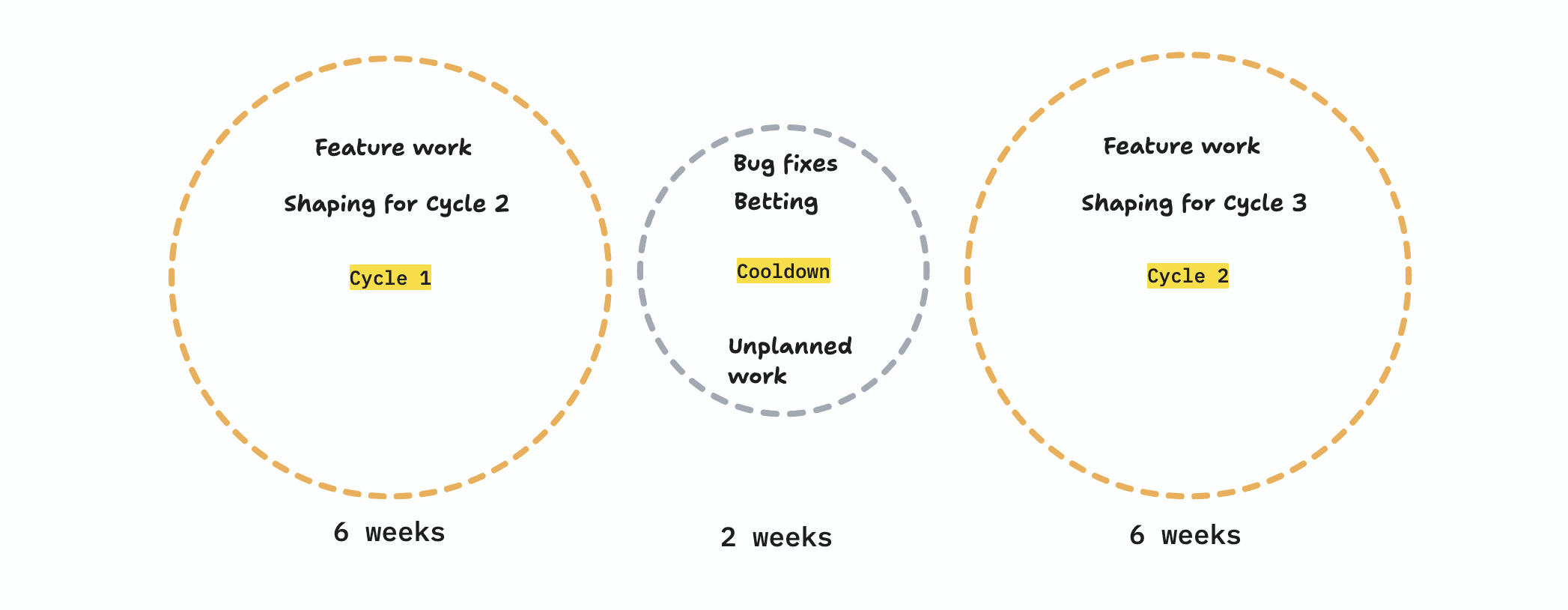
Cycles
When we introduce Shape Up to a new company, we always start with Cycles. They're the most confronting part of the methodology but also the most impactful.
What is a cycle?
A cycle is the time it takes you to deliver a midsized project. Shape Up calls these projects "Pitches". In the Shape Up book, cycles are defined as 6 weeks. Depending on your business, you may decide to do shorter cycles, although we don't recommend dipping below 3 weeks.
Cycles start and end at the same time. That means if you want to work on 4 pitches, you start all four pitches on the same date, and end them all on the same date. We'll dig into why this is important later.
Cooldown
Between cycles there is something called a cooldown. A cooldown is a period of unallocated time. That means that engineering teams work on whatever they deem most important for that period of time. Traditionally cooldown is 2 weeks long, although if you're doing shorter cycles you might also want to opt for a shorter cooldown.
Do cycles have to be 6 weeks?
The 6 week cadence is what seems to work best for most midsized SaaS companies, but every place is different and you may opt for a different cadence. What's more important is that your teams feel they are given sufficient time to solve a given business problem to a high enough standard.
The best way to pick the right cadence for your company is to take the last few projects you delivered. If, from start to finish, they took more than 5 or 6 weeks, pick six weeks. If they took less than 5 weeks, pick 3 or 4 weeks. Remember, we're talking about entire projects here, not just tasks.
As far as cooldown is concerned. If you're doing cycles of 4 weeks or less, just do a 1 week cooldown. Otherwise stick with the two weeks.
Cycles that are longer than 6 weeks are possible, but we wouldn't recommend starting with them. Do a few cycles at 6 weeks first and see where the tension lies.
Can I skip cooldown?
We strongly recommend that you do not get rid of cooldown. If pitches are bricks, then cooldown is the mortar that holds them all together. Technical debt, meetings, bug fixes, cleanup from cycles, refactoring, non-engineering tasks - there is an infinite list of "stuff" that needs catching up on when we're focused on delivering a given cycle feature. Cooldown gives your engineers confidence that they can commit wholeheartedly to their cycle work.
If cooldown sounds like a challenge, we ask you trust us for a single cooldown. Providing you have a well aligned team (this is what Rough is built for), I guarantee you'll see almost every metric improve over that two week period.
What if an urgent bug comes in mid-cycle?
This is where we diverge from what's written in the Shape Up book. We recommend carving off a separate worksteam called "Rapid Response" to deal with urgent, reactive work. Shape Up is not designed to handle reactive work, and it's easier to resource it separately.
If you'd like to be closer aligned to the book- bugs are fixed during cooldown, showstopper bugs are exactly that, they stop the show. Your cycles may be impacted by them.
What if a team finishes early?
If a team finishes very early, you may have another pitch they can pick up. We call these smaller pitches "Small Batch" work and you'll find yourself with a healthy backlog of them naturally.
If a team finishes with a few days left in the cycle, they can always be moved to rapid response to pick up some bugs, or they can start their cooldown earlier. Honestly, having spare engineering and product resources is a rarity, and it's usually not difficult to find important things for them to do.
What if a team finishes late?
This is a more difficult situation. Projects finishing late are the bane of many a team and it's one of the main claims of Shape Up to solve. By the book, a late project is a failed project. The team working on it should pull the plug and reflect on what went wrong.
We don't think the book is realistic here. Sinking 6 weeks of work into a project and then abandoning it is hard. In almost every case you're going to want to salvage some of that work.
Option 1: The work leaks into cooldown. This is ok if there's a couple of small things left over. We don't want to start down the slippery slope of allocating work for cooldown, but stuff happens and we can't be too dogmatic here. In reality, engineers will genuinely want to finish their cycle project so there's no need to be overly concerned. It's not something to start relying on though, and your team will notice if it starts happening every time.
Option 2: Repackage the work into Small Batch. Re-shape the work you have left over and commit to a small batch. This means putting another 2-3 weeks into the project, but this exercise will give you confidence it will actually be delivered.
Option 3: Reshape. This means stopping, taking a breath, and going back into shaping. If a project has run massively over there were probably many reasons for this. Is it better to treat the first cycle as an experiment, or a proof of concept? Did we skip certain stakeholder conversations? Was the cycle derailed by unexpected technical complexity?
If we reshape, we probably can't work on the work next cycle. We get the chance to derisk the future of the project, but we lose some immediacy with the delivery.
Option 4: Repackage the work into another cycle-length pitch. This is the last thing we recommend because usually if you finish a cycle, and you unexpectedly find that you need an entire second cycle, there might be some bigger risks with this project. However, if you're confident that another cycle will let you deliver this work you can quickly repackage it and carry it into the next cycle.
Under none of these options do we skip cooldown and work through the 2 weeks. Working through the whole of cooldown is a huge red flag, and should be avoided.
Will cycles work for you?
For most midsized companies, especially in the software space, cycles offer a fresh way to approach work while mitigating the issues that come with day-to-day delivery. If you'd like some support for your first few cycles, reach out to us, we're happy to help.